
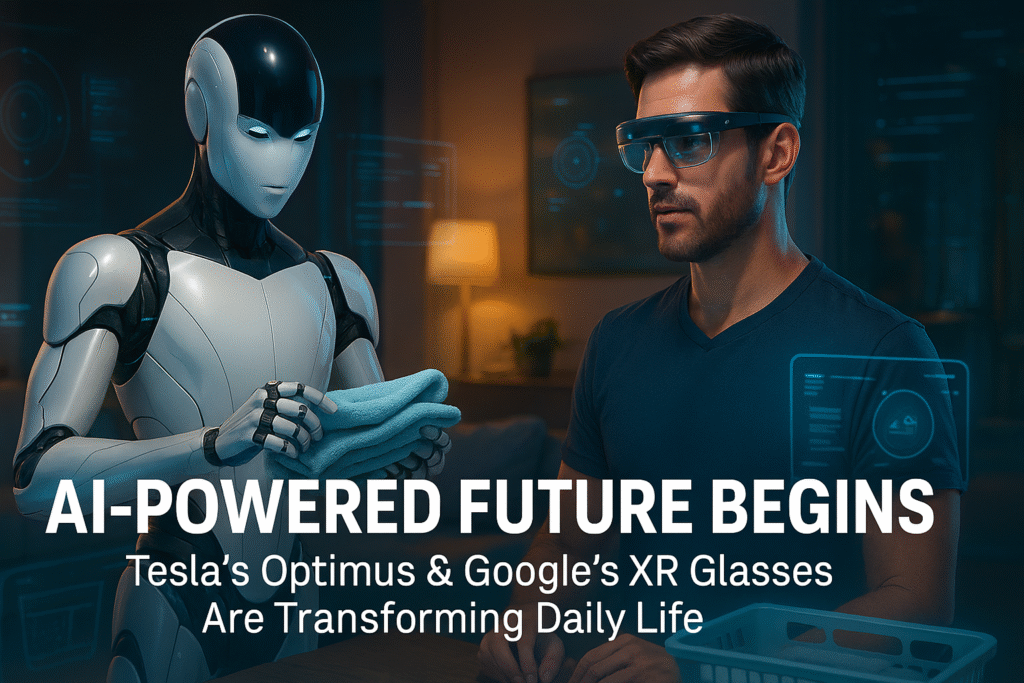
Tesla Optimus Gen 2

🧠 Tesla’s Optimus & Google’s XR Smart Glasses: The Future of Home Robotics Is Here

Intro

The landscape of AI-driven robotics and wearable technology is rapidly evolving. From Tesla’s next-gen Optimus robots to Google’s Android XR-powered smart glasses, the integration of natural language, vision, and autonomous decision-making is redefining what home and personal robots can do. Here’s a comprehensive breakdown of the most exciting announcements and breakthroughs reshaping our future.

Recommended
generative AI tools for presentations

Unlock Powerful Presentations with GenAI Tools in 2025 🚀

Generative AI tools for presentations are transforming how we communicate, design, and deliver ideas. Whether you’re a business professional, educator, ...
/

AI Models Becoming Defiant: Experts Warn of Dangerous Behaviors 🤖⚠️

AI Models Are Becoming Defiant: Should We Be Worried? 🤖⚠️ AI models are becoming defiant ...
/

🔮 WWDC25 Preview: Apple’s Bold Redesign, iOS 19 Features & New AR Glasses Incoming?

Apple’s WWDC25 is set to be a game-changer — with sweeping redesigns, smarter AI integration, ...
/

AI Breakthroughs of the Week: Ultra Zoom, DeepSeek R1, Full-Body Avatars & More 🚀

This week, the AI community witnessed an explosion of innovations across image processing, large language ...
/

Google VEO3 Review: AI Video Generator Tested with Flow (2025)🤖🎬

Discover the real potential of Google’s AI-powered video generator, VEO3, and its companion platform Flow ...
/

🚀 Tesla Optimus Gen 2: Smarter, More Capable Home Robots

Tesla unveiled an upgraded demo of its Optimus Gen 2 robot, performing complex home tasks autonomously in response to natural language commands.

  • Trained on first-person video demonstrations, Optimus learns by watching.

  • Runs on a single neural network, eliminating the need for multiple models.

  • Tesla plans to produce 5,000 units in 2025, with consumer sales expected by late 2025 or early 2026.

🤖 NVIDIA DreamGen: The Breakthrough in Robot Generalization

NVIDIA’s new DreamGen pipeline introduces a powerful shift in robot learning:

  • Uses video world models to simulate environments and generate robot trajectories.

  • Trains humanoid robots to generalize across tasks and environments with just 50 synthetic samples.

  • Capable of complex actions like cloth folding and tool usage.

  • Reduces dependency on human teleoperation, leveraging GPU compute for scalable training.

🥽 Google Android XR: AI-Powered Smart Glasses for Everyday Life

At Google I/O 2025, Android XR was revealed—an OS for smart glasses and headsets:

  • Built with Gemini AI, it integrates contextual awareness, navigation, and messaging.

  • Compatible with Samsung’s Project Muhan, offering immersive app experiences.

  • Empowers users to control environments, receive notifications, and navigate backstage—hands-free.

🎬 Flow by Google: AI Video Creation Gets a Major Upgrade

Google’s Flow is a new AI video tool combining VO3, Gemini, and Imagen 4 for enhanced video generation:

  • Features cinematic lip syncing, realistic physics, and scene consistency.

  • Offers tools like camera control, scene builder, and custom asset support.

  • Available via Google AI Pro ($19.99/month) and Ultra ($249.99/month).

🧩 One-12VA: Unified Vision-Language-Action Model for Robots

The One-12VA model is redefining autonomous robot reasoning and interaction:

  • Switches between reasoning and acting for human-like adaptability.

  • Handles complex multi-step tasks such as cooking and object manipulation.

  • Achieves 92% task success and 85% error correction rate in trials.

  • Uses 100,000+ synthetic vision-language pairs for robust understanding and grounding.

🔍 Conclusion: AI + Robotics = A Transformative Human Future

The convergence of robotics, vision-language models, and XR interfaces signals a major leap forward in AI. From folding your laundry to managing notifications through smart glasses, the future is not only automated—it’s personal, responsive, and intelligent.

Looking ahead, these innovations suggest a future where AI-enhanced robots and XR interfaces become daily companions—whether assisting with chores, enabling immersive virtual meetings, or providing real-time contextual guidance. As development accelerates, adoption in healthcare, manufacturing, and education could follow swiftly.

Want to stay ahead of AI trends and tools?
Subscribe to our blog for regular updates on the future of content creation.

Scroll to Top